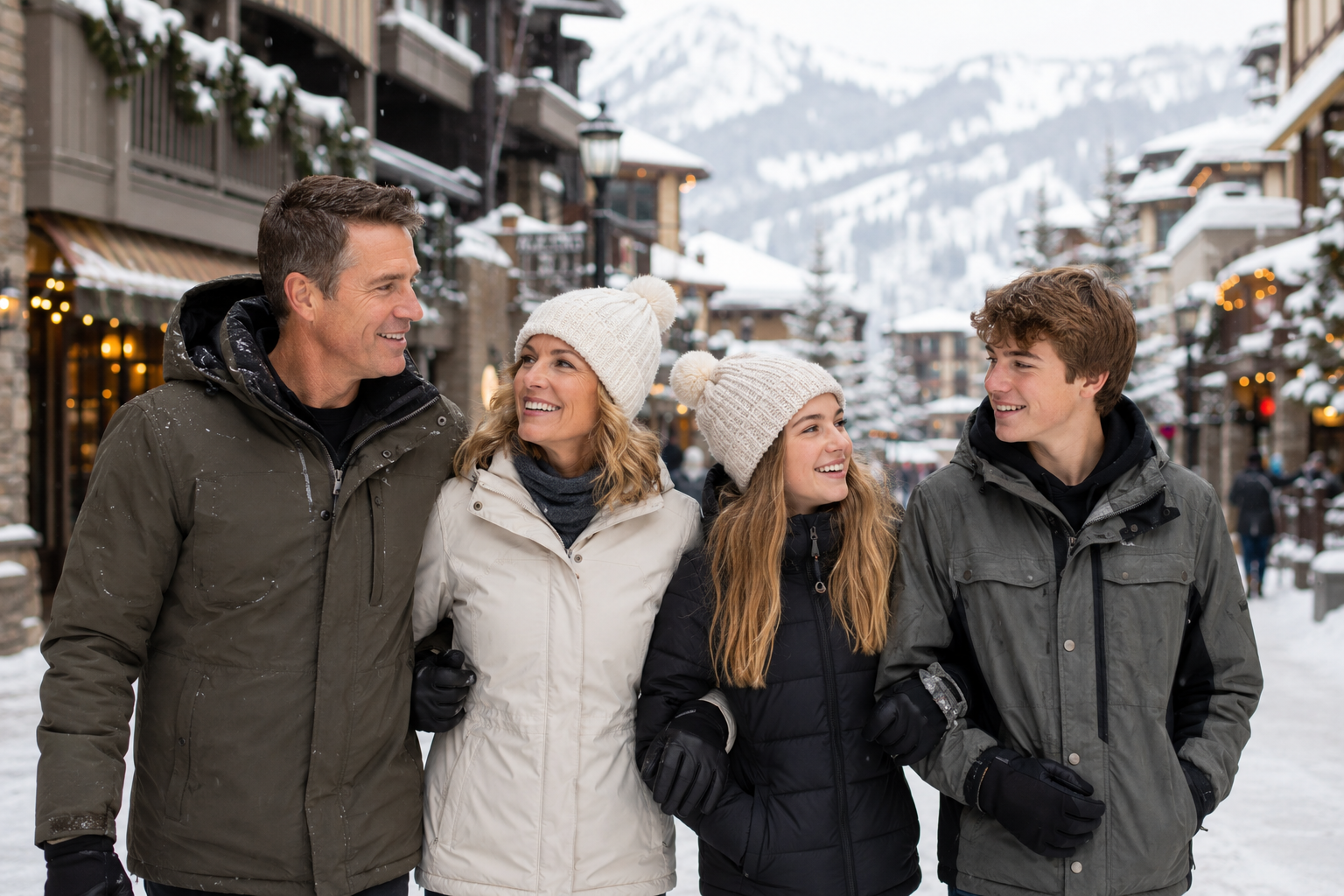
There is a version of ski-town living that exists in every brochure, every listing photo, and every Instagram reel shot at golden hour on a powder day. It looks like heaven. Crisp alpine air, snow-covered peaks, a tight community of interesting people, and a life that feels like a permanent vacation from everything ordinary.
That version is not a lie. But it is a highlight reel. And the distance between a highlight reel and an ordinary blue-sky winter day in February at 8,000 feet is where most buyers get it painfully wrong.
I have done the winters. Not visited them. Lived them. Whether it’s Aspen, Vail, Steamboat, Park City, or Deer Valley, the gap between what a ski town sells you and what it actually asks of you is worth understanding before you sign anything.
The altitude is not a detail. It is a lifestyle.
Most people think about altitude as a number on a welcome sign when they drive into town. It is not. It is a physical reality that shapes every part of your daily life, and your body does not care how much you love the view.
At 7,000 to 10,000 feet, sleep changes. Energy changes. Recovery after exercise changes. Alcohol hits differently. Hydration becomes a discipline, not a choice. Some people adapt in weeks. Some never fully do. And almost nobody talks about this when they are shopping for a home with a mountain view.
If you are in your fifties or sixties, moving to altitude is a medical conversation, not just a lifestyle one. If you are having shortness of breath or mild headaches, you may want to talk to your doctor before you talk to an agent. That is not dramatic. It is practical, and it is the kind of thing the brochure will never mention because it does not sell condos.
Seasonality is not charming. It is structural.
You know this, but I’m going to add a few meaningful items you may not have thought about. Ski towns run on seasons, and the shoulder season, graciously called Mud Season, is the part nobody photographs. When the lifts close and the tourists leave, a lot of these towns get very quiet. Some businesses shut down. Restaurants cut hours or close entirely. The energy that made the place feel alive in December can feel like a ghost town from mid-April to early June, and again from late October to early December.
For some people, that quiet is exactly what they want. For residents, it is welcomed, even in an isolating way. The question is not whether you love ski season. The question is whether you love the town when ski season is over and there is nothing to do but live there. However, there is a saying shared among many ski towns across the Rocky Mountain West: “People vacation here for the winters, but they live here for the summers.” And if you love mountain biking and other active sports, resort mountain towns are a gold mine for fun, but with that comes the expense of living.
This is an any-day-in-winter type of test. Understanding the down time is as important as the up time. If your only answer is “I don’t know,” you have not spent enough time there to buy.
The cost of living is not what the listing price suggests.
People look at a home price in a ski town and think that is the number. It is not even close. The listing price is the entrance fee. The ongoing cost is where it gets real. I’m now in Hilton Head, South Carolina, enjoying the days at the beach and Indigo Run Golf Course and Harbour Town, but I miss the mountains dearly. And with every resort town, the listing price on a home is exactly what I said: the entrance fee. In Park City, before relocating for my tenth time in the United States, the average home sale in Park City was $1.6 million dollars. Yes, your basic 2,400-square-foot home.
Then you have heating a home at altitude through a seven-month shoulder season and winter, which is expensive. Property taxes in resort towns are higher than comparable non-resort markets. And if you are a second-home owner, including a vacation property, yes, you are charged just a squigid more in property taxes each year. 🙂 Insurance, especially in wildfire-prone mountain corridors, has been climbing aggressively. HOA fees in ski-in/ski-out communities can be staggering. And then there is the cost of simply living there: groceries, contractors, services, and labor all run higher in towns where the workforce has been priced out of living locally.
None of this is a reason not to buy. All of it is a reason to know the real number before you fall in love with the wrong one. And dare I say it now, the agent you pick is critical to your decision-making process. In my extensive experience, most of them are not your go-to agent unless you want an unfavorable outcome. But more about that later.
The community is real, but it is earned.
One of the best things about ski towns is the community. The people who live there year-round tend to be intentional, active, and genuinely connected. It is one of the strongest draws, and it is real. I found it to be the best part of living in resort towns, so long as you leave your negative attitude and politics at the door.
But it is not instant. These are small towns with tight social circles, and locals can spot a newcomer who bought the fantasy and will be gone in two years and leave a pile of excrement attitude in their wake. Building genuine community in a ski town takes time, presence, and commitment to being there through the off-season, not just the glamorous months.
If you are relocating full-time, you can earn that. If you are buying a second home you will visit six weeks a year, be honest with yourself about whether you will ever truly feel like you belong. That is not a judgment. It is a question worth answering before you invest. I have acquaintances who visit every year, and we’d just continue on where we left off. Nothing deep and meaningful about the friendship, but a friendship designed around seasonal migratory patterns, not dissimilar from birds or wildebeest. Be social, be happy and enjoy the mountain spirit.
Remote work changed the equation, but not the fundamentals.
The wave of remote workers who moved to ski towns during and after the pandemic changed these markets permanently. Prices jumped. Inventory tightened. And a new population arrived that wanted the lifestyle without necessarily understanding what year-round mountain living actually demands.
Some stayed and thrived. Some discovered that reliable internet at 9,000 feet is not guaranteed, that winter road closures affect more than your commute, and that the isolation that felt romantic in theory felt very different when it was dark by 4:30 in the afternoon for four months straight, and only then you realized you were out of wine or milk and had to drive on sheer ice for 30 minutes at 2 miles an hour to get through the next 24 hours. You think I joke? I do, but the stories are hysterical sometimes.
If your plan depends on working remotely from a ski town, stress-test it. Not against the best week. Against the worst one.
The right ski town and the famous ski town are not always the same place.
Aspen, Vail, Park City, Jackson Hole, Telluride. These are the names everyone knows, and they are extraordinary places. They are also among the most expensive markets in the country, with price points, tax structures, and community dynamics that may or may not fit what you are actually building.
There are ski towns and mountain communities across the Rockies and beyond that offer a version of the life at a fraction of the cost and with a very different character. The famous town is not automatically the right town. The right town is the one that fits your life, your budget, your family, and your tolerance for what the mountains actually ask of you. And much of it comes down to which move you are really making. If it’s a full relocation, are kids involved, and what do they need? If it’s a second home, seclusion from the chaos is fine, even the point. If it’s a vacation property, you likely want to be where the action is, close to the energy that makes the place worth renting and returning to.
That is the work I do. Not selling you a town or a home. Helping you figure out which one actually fits, by asking the questions no one else knows to ask. Then reverse-engineering the importance of your must-haves, so you go in with clarity. And only then connecting you with a highly vetted, hyper-local advisor who knows that specific market cold with the specialty service that you would expect at a Forbes 5-Star hotel. The agent comes last. The clarity comes first.
The brochure is not wrong. It is just incomplete.
Ski-town living can be extraordinary. The air, the mountains, the pace, the people, the sheer beauty of waking up in a place that most humans only see on vacation. That is real, and for the right person, it is worth every trade-off on this list.
But “the right person” is not everyone who loves to ski. It is the person who has done the honest work of understanding what the life actually costs, what it actually feels like in the off-season, and whether their body, their family, and their future self will thrive there year-round. If you are not active and do not love being outdoors, you will likely not love it here. And if you are carrying enough extra weight that your health is already compromised, altitude will not be kind to you. That is not a judgment. It is physiology. Being able to breathe normally at 8,000 feet is not a preference. It is a prerequisite.
Do not buy the brochure. Buy the life. And make sure you know which one you are looking at before you sign.
Get clear first. The rest follows.